Introduction: Why The Global Bridges Initiative? Why This Question Matters Now
The question “Why the Global Bridges Initiative?” cannot be answered meaningfully without first confronting the present governing reality of U.S. foreign policy. Under the second administration of President Donald J. Trump, the United States has moved decisively away from expansive multilateralism and broad foreign-aid commitments toward a posture defined by aid discipline, transactional engagement, visible security action, and strict alignment with presidential priorities.
This shift is not simply rhetorical. It has manifested in:
- formal reviews and reductions of foreign assistance,
- withdrawal from multilateral prevention and resilience frameworks,
- heightened emphasis on security threats in West and Central Africa,
- renewed restrictions on mobility from several African countries.
These changes do not reduce Africa’s importance to the United States. On the contrary, they raise the stakes. As U.S. tools narrow, the margin for error in engagement shrinks. Misalignment becomes costlier; backlash more likely; legitimacy harder to regain once lost.
The Global Bridges Initiative exists because the United States now needs fewer but smarter instruments; capabilities that improve outcomes without expanding bureaucracy, entrenching dependency, or contradicting an “America First” governing logic. Intercultural infrastructure is one such capability.
I. The New Policy Constraint: Less Aid, Fewer Platforms, Higher Risk
The second Trump administration has made explicit what earlier administrations often implied: foreign assistance and engagement are not entitlements; they must justify themselves in terms of U.S. national interest. Large, diffuse aid architectures and multilateral prevention mechanisms are increasingly viewed as inefficient, ideologically captured, or misaligned with presidential authority.
In Africa, particularly West and Central Africa, this retrenchment collides with reality. These regions face:
- escalating security threats,
- democratic fragility and coups,
- youth unemployment and political mobilization,
- intensified competition from China, Russia, and regional powers.
The paradox is stark: U.S. engagement is becoming more selective at the same moment Africa is becoming more consequential.
Under these conditions, the traditional model—fund-heavy, bureaucracy-driven, externally designed programs—becomes politically and operationally untenable. What replaces it cannot simply be force or trade alone. Security action without legitimacy produces blowback. Trade without cultural intelligence produces failed deals and reputational damage.
Global Bridges is designed precisely for this constraint environment: low-cost, high-leverage, non-bureaucratic, and competence-driven.
II. West and Central Africa: Where Transactional Power Breaks Down
West and Central Africa are not marginal theaters; they are stress tests for U.S. offering power under current policy constraints.
These regions exhibit three characteristics that make purely transactional engagement brittle:
- Plural Authority Systems
Formal governments coexist with traditional councils, religious authorities, kinship structures, and informal networks that retain real decision-making power. - Historical Sensitivity to External Intervention
Colonial memory, Cold War proxy politics, and recent counterterrorism campaigns shape how U.S. actions are interpreted, often skeptically. - Dense Foreign Competition
China’s infrastructure diplomacy, Russia’s security messaging, and Gulf state religious influence operate through culturally resonant narratives and long-term presence.
In such contexts, visible power without cultural literacy does not project strength; it signals distance. Counterterrorism strikes, trade missions, or democracy pronouncements that bypass local communicative norms may satisfy short-term signaling needs but degrade long-term influence.
Global Bridges intervenes here by reframing engagement from delivery to interpretation: who speaks, how authority is acknowledged, and how legitimacy is communicated.
III. The Strategic Blind Spot: Culture Treated as Ornament, Not Infrastructure
Even in the current administration’s most hard-nosed formulations, one assumption remains largely unexamined: that policy effectiveness depends primarily on material leverage. Yet decades of research in political anthropology, organizational communication, and conflict studies demonstrate the opposite: outcomes depend on legitimacy pathways.
Cultural diplomacy, in this sense, is not art exhibitions or symbolic exchange. It is operational infrastructure; the difference between:
- compliance and quiet resistance,
- intelligence and misinterpretation,
- partnership and performative alignment.
Where U.S. programs have failed in West and Central Africa, postmortems repeatedly reveal not lack of resources, but misreading of authority, communication style, and social sequencing. Agreements reached with formal officials collapse because informal consensus was never built. Programs announced publicly falter because moral authorities were bypassed privately.
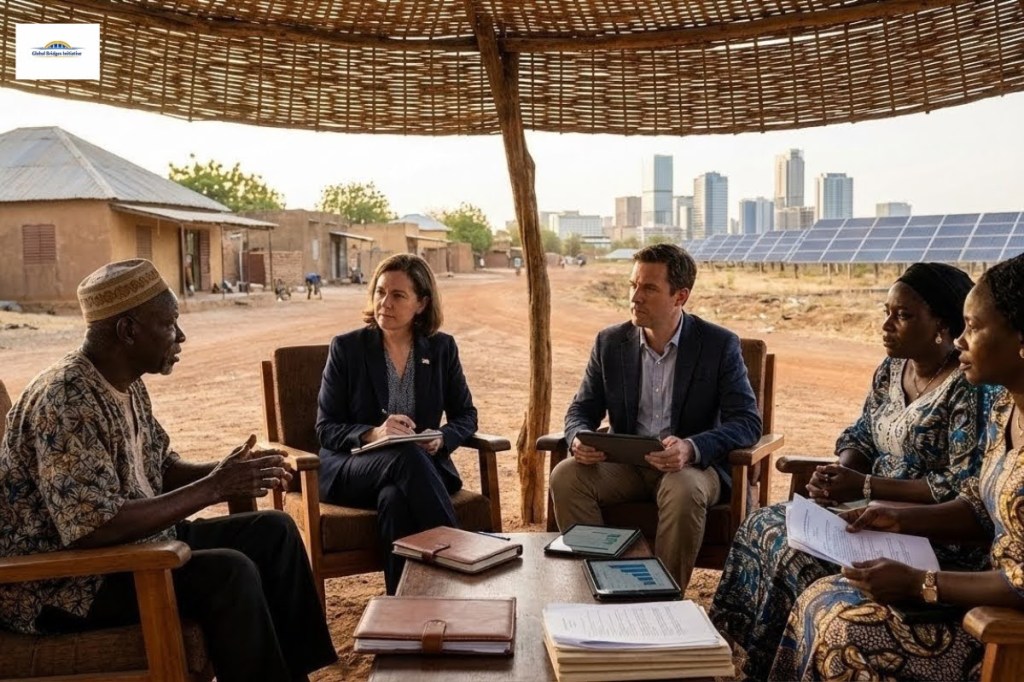
Global Bridges exists to correct this structural blind spot by systematizing intercultural competence as a deployable capability, not an afterthought.
IV. Why Global Bridges Fits The Current American Logic
The Global Bridges Initiative is not a call for expanded aid, new multilateral bodies, or open-ended commitments. It is a capability proposition that aligns with current U.S. priorities in four critical ways:
1. Aid Discipline and ROI
Global Bridges focuses on training, research, and advisory capacity that improves the effectiveness of existing engagements; doing more with less, rather than asking for more.
2. Security Effectiveness
Intercultural competence reduces miscalculation, backlash, and intelligence failure. It is a force multiplier for security objectives, not an alternative to them.
3. Domestic Advantage via Diaspora
African diaspora communities in the U.S. are domestic assets—citizens and residents whose cultural fluency and transnational networks can advance U.S. interests without foreign entanglement.
4. Digital and Flexible Engagement
As mobility tightens and institutions retrench, Global Bridges’ emphasis on digital platforms and modular training ensures continuity of engagement without physical expansion.
In short, Global Bridges does not resist the current administration’s posture; it operationalizes it intelligently.
V. The Cost of Not Building Intercultural Infrastructure
If the United States continues to narrow its tools without upgrading its competence, the likely outcomes are predictable:
- increased reliance on episodic force,
- fragile trade partnerships,
- intelligence blind spots,
- declining credibility among African youth and intermediaries,
- accelerated displacement by actors willing to invest in cultural presence.
None of these outcomes serve U.S. national interest—particularly under an administration that prizes strength, leverage, and deal durability.
Global Bridges is a preventive investment against these risks.
Conclusion: Why Global Bridges—and Why It Is Politically Timely
The Global Bridges Initiative is necessary not because the United States needs to “feel better” about its role in Africa, but because its margin for error has narrowed. Under a second Trump administration, the question is no longer whether the U.S. engages Africa, but how effectively it does so with fewer tools and higher stakes.
Intercultural infrastructure is not ideological. It is not partisan. It is strategic competence.
Global Bridges exists to ensure that when the United States acts—whether in trade, security, diplomacy, or community engagement—it does so with interpretive precision, legitimacy awareness, and reduced risk of failure.
That is why the initiative is not only compatible with current U.S. priorities.
It is, under present conditions, decisively necessary.
 Global Bridges
Leave a comment