Reframing Intercultural Engagement as Strategic Capability
Policy Note
Global Bridges
January 2026
Executive Summary
Influence in contemporary Africa is increasingly shaped by perceived relational credibility—whether external partners are seen as respectful, present, and attentive to local priorities—rather than by aid volumes or episodic high-level engagement alone. Public-opinion data underscores both an opportunity and a warning for the United States. In Afrobarometer’s cross-national findings (34 countries, Round 8), Africans’ views of U.S. influence are broadly positive (about 60% positive vs. 13% negative), closely tracking views of China’s influence (about 63% positive vs. 14% negative). Yet the same dataset shows substantial country variation, with China perceived more positively than the U.S. in a sizable subset of countries, indicating that “U.S. influence” is not a uniform continental reality but a locally contingent outcome.
This discussion is especially urgent in the current global context, marked by intensified great-power competition, rising skepticism toward external intervention, and a growing demand among African publics for partnerships grounded in respect, continuity, and local relevance. As geopolitical influence increasingly hinges on perception, legitimacy, and trust, rather than coercion or capital alone, the strategic value of culturally intelligent engagement has become central to contemporary foreign policy outcomes.
The central argument of this note is that cultural diplomacy and intercultural competence should be treated as strategic capability—a form of operational infrastructure for trust, policy uptake, and durable partnership—rather than as a symbolic “soft” adjunct to security and development. This recommendation is not aspirational; it is consistent with evidence from public diplomacy practice, including measurable outcomes from U.S.-funded exchange networks such as the Mandela Washington Fellowship (YALI), which has engaged nearly 6,500 leaders from all 49 sub-Saharan African countries, with alumni survey indicators pointing to downstream leadership and civic engagement effects.
The Changing Landscape of Influence in Africa
Africa’s strategic importance in global politics has expanded alongside demographic growth, new markets, and intensifying external courtship. Yet influence is no longer secured primarily through the existence of partnerships; it is secured through how those partnerships are experienced—locally and repeatedly—by citizens, communities, and intermediaries who interpret external engagement through historical memory and everyday interaction.
Afrobarometer’s “preferred development model” question illustrates a key nuance: on average, Africans more often select the United States (33%) than China (22%) as a model for national development, with the U.S. favored over China in 23 of 34 surveyed countries (and China leading in five). This suggests that U.S. normative appeal remains substantial—but it is not automatically converted into influence. The conversion depends on whether U.S. engagement is interpreted as respectful, sustained, and locally intelligible.
Crucially, African publics do not evaluate external actors in abstraction. They evaluate them through visible practices—how projects are communicated, who is consulted, how disagreements are handled, and whether engagement persists beyond a funding cycle. Where U.S. engagement is perceived as rotating personnel, short-horizon programs, or limited attention to local authority systems, influence can decay even in contexts where the U.S. remains admired as an aspirational model.
Understanding the changing landscape of influence in Africa requires moving beyond perceptions and preferences to examine the mechanisms through which influence is produced. Central among these mechanisms is cultural diplomacy—not as symbolic exchange, but as operational infrastructure.
Cultural Diplomacy as Strategic Infrastructure
Cultural diplomacy is often misconstrued as “image work.” In practice, it functions as cooperation infrastructure: it shapes the communicative conditions under which agreements are trusted, programs are adopted, and partnerships endure.
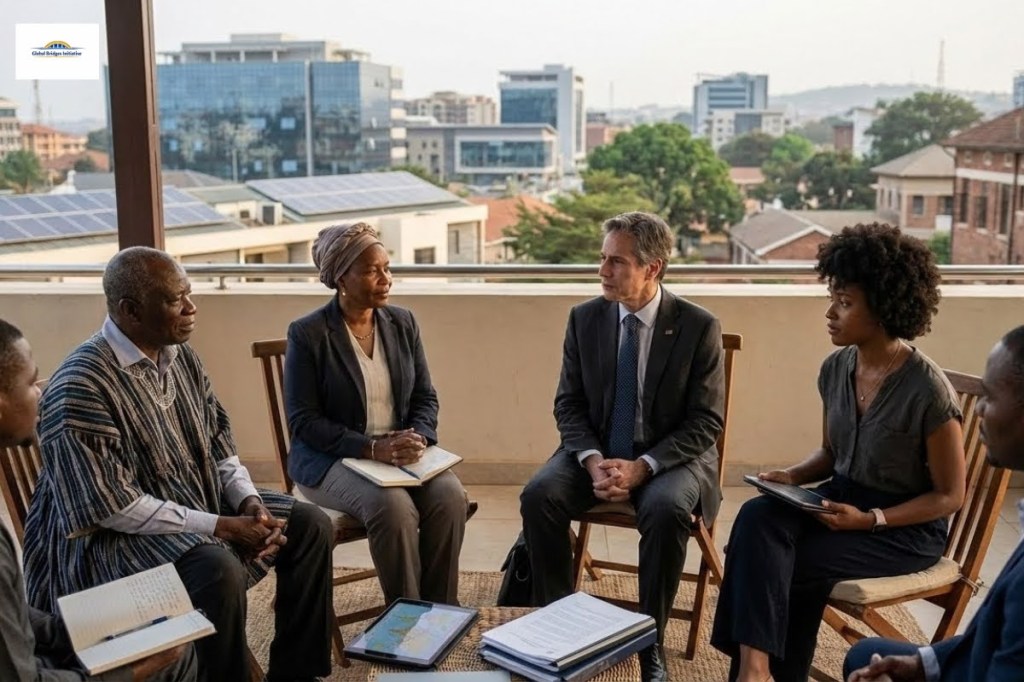
For example, U.S. diplomatic missions that have invested in sustained engagement with local cultural interlocutors—such as religious leaders, traditional authorities, or respected civic figures—have often been better positioned to navigate moments of political tension. In several West African contexts, embassy-led dialogue initiatives that relied on trusted local intermediaries were able to de-escalate community resistance to security or governance programs that initially faced skepticism when communicated solely through formal state channels.
The practical point is visible in governance and accountability programming. A recurring finding across decentralization and local-governance scholarship is that formal state institutions frequently coexist with customary or traditional authorities who retain moral legitimacy and mobilizing capacity in many communities. When governance interventions engage only formal institutions while bypassing customary authority and community deliberative practices, uptake can weaken—not necessarily through open resistance, but through low participation, limited compliance, or quiet substitution by informal systems.
Similarly, in development practice, programs that embedded cultural consultation at the design stage—rather than as post-hoc outreach—have demonstrated higher levels of participation and durability. Governance initiatives that aligned accountability mechanisms with locally recognized deliberative forums (such as community councils or customary assemblies) were more likely to achieve compliance and sustained engagement than those that relied exclusively on externally defined institutional templates.
These examples illustrate a core point: cultural diplomacy does not replace formal policy instruments, but conditions whether those instruments function as intended.
This is not a normative argument for customary authority over democratic institutions. It is a strategic argument about legitimacy pluralism: in many settings, legitimacy is co-produced through both formal and customary channels, and external partners ignore this at operational cost. The implication is that cultural diplomacy is not ceremonial; it is the capacity to design and communicate policy in ways that align with local legitimacy structures.
If cultural diplomacy provides the infrastructure for cooperation, intercultural competence constitutes the skill set through which that infrastructure is activated in everyday diplomatic, economic, and developmental practice.
Intercultural Competence as a Strategic Asset
Intercultural competence is too often reduced to “cultural awareness.” A more policy-relevant definition is the ability to navigate disagreement, hierarchy, negotiation tempo, and trust-building across difference—especially in environments shaped by colonial legacies and contemporary foreign competition.
Here, African public opinion again provides a useful interpretive lens. Thinktanks show that in multiple countries China is perceived as having more positive influence than the U.S., while in others the U.S. leads. This pattern indicates that the question is not “Does Africa prefer the U.S. or China?” but rather: Under what local conditions does U.S. engagement convert into perceived positive influence? Intercultural competence is one of the key conversion mechanisms: it affects how U.S. intent is interpreted and whether partnerships are experienced as reciprocal or extractive.
Operationally, this has direct economic consequences as well. Negotiation styles, expectations about relational pacing, and norms of deference and consultation can determine whether cross-border partnerships form and persist. Intercultural competence therefore functions as a productivity tool: it reduces friction, increases legitimacy, and improves the durability of agreements.
The Role of Diaspora Communities
One of the United States’ most underutilized assets in African engagement is its African diaspora. Diaspora communities possess linguistic fluency, cultural literacy, and transnational networks that enable them to act as effective cultural translators.
In several U.S. cities, diaspora-led initiatives have quietly succeeded where formal diplomacy struggled. For instance, diaspora professionals have facilitated conflict mediation between U.S.-based NGOs and local communities in Africa by reframing project goals in culturally resonant terms and identifying credible local intermediaries. Yet such contributions are rarely institutionalized; they depend on personal networks rather than policy design.
Systematically integrating diaspora expertise would allow U.S. institutions to anticipate cultural misalignments, identify trusted interlocutors, and build legitimacy more efficiently than through external consultancy alone.
Evaluating intercultural competence solely from the perspective of external actors, however, risks reproducing the very asymmetries this paper critiques. A fuller assessment must incorporate how engagement is interpreted by African publics and stakeholders themselves.
Broader Perspectives: What Local Stakeholders Signal
A balanced representation requires moving beyond U.S.-centric accounts of intent to incorporate what African stakeholders and publics actually indicate as meaningful.
Two signals stand out, especially from Afrobarometer’s findings:
- African publics differentiate between “influence” and “model.” Many may see Chinese economic activity as consequential while still preferring the U.S. model of development, governance, or aspiration.
- Perceptions are heterogeneous and context-specific. Some countries show substantial gaps in perceived positive influence (in either direction), underscoring that “U.S. credibility” is locally produced, not centrally declared.
This means U.S. strategy should be less about continent-wide messaging and more about context-responsive engagement, including consistent consultation with local intermediaries (civil society leaders, traditional authorities where relevant, youth networks, professional associations, and diaspora connectors) who can translate U.S. initiatives into locally legitimate practice.
While diagnostic critiques are necessary, policy relevance ultimately depends on demonstrating what effective cultural diplomacy looks like in practice. Several U.S. initiatives provide instructive examples of how culturally grounded engagement can generate durable influence.
Examples of Success: What Effective U.S. Cultural Diplomacy Looks Like
Three U.S. public diplomacy instruments provide concrete, measurable indicators of cultural engagement producing downstream capacity and relational effects.
A. Mandela Washington Fellowship (YALI): Elite-to-Community Ripple Effects
The Mandela Washington Fellowship reports engagement of nearly 6,500 young leaders from all 49 sub-Saharan African countries. In a 2023 alumni survey referenced in program impact materials, 91% of respondents reported that participation motivated them to take on a leadership role in their communities, and 92% reported volunteering in their community at least once within the last year. Program documentation also reports large volumes of professional training and reciprocal exchange projects linking U.S. and African actors.
Independent commentary has explicitly described YALI as a U.S. soft-power instrument, noting early cohort characteristics (e.g., high rates of civic and entrepreneurial engagement) consistent with leadership-network effects.
B. Peace Corps: Measurable Community-Level Effects and “People-to-People” Credibility
Peace Corps host-country impact studies provide quantifiable snapshots of community-perceived benefit. For example, in Mali’s Small Enterprise Development Project impact summary (based on interviews across 14 communities), 98% of partners/beneficiaries reported the project was moderately to greatly beneficial to their organizations and communities; 83% of partners reported organizational changes were sustained.
While this is not a direct “favorability” metric, it is an outcome pathway: sustained, community-attributed benefits are precisely the kind of experiential credibility that cultural diplomacy requires.
C. Alumni Engagement Innovation Fund: Converting Exchange into Local Projects
The U.S. Department of State’s Alumni Engagement Innovation Fund (AEIF) explicitly funds alumni of U.S.-sponsored exchanges to implement community projects that extend exchange benefits into local impact—an institutional design that treats cultural exchange as durable civic infrastructure, not a one-off experience.
Taken together, these examples illustrate an evidence-based proposition: cultural diplomacy works best when it builds networks that remain active, locally embedded, and project-generative after the “event” ends.
Policy Implications and Recommendations
To recalibrate its position in contemporary Africa, the United States should pursue the following strategic shifts:
- Institutionalize Intercultural Training
Training should move beyond cultural “do’s and don’ts” to focus on real-world scenarios: negotiating authority, managing disagreement, and building trust in specific regional contexts. - Integrate Cultural Analysis into Policy Design
Cultural impact assessments should be conducted alongside economic and security analyses, particularly for governance, peace-building, and development initiatives. - Leverage Diaspora as Strategic Infrastructure
Diaspora actors should be engaged systematically in advisory, design, and evaluation roles—not as symbolic representatives, but as operational partners. - Support Research-Driven Cultural Diplomacy
Applied research grounded in ethnographic and communication scholarship should inform training and policy development. - Prioritize Long-Term Relational Engagement
Success metrics should include relational durability, local legitimacy, and trust—not only short-term outputs.
Taken together, these findings point to a clear strategic implication: the United States’ influence in Africa is neither predetermined nor exhausted, but contingent on whether cultural diplomacy is treated as peripheral symbolism or core operational capability.
Conclusion
The United States retains significant normative appeal in Africa, but influence is increasingly determined by how engagement is lived at the local level—not by how it is announced at the diplomatic level. Public-opinion evidence shows that Africans often view U.S. and Chinese influence as broadly positive in comparable proportions, while simultaneously differentiating between models of development and country-specific experiences of external engagement. That reality should be read as a strategic opening: U.S. influence is still contestable—and therefore still buildable—through the deliberate institutionalization of cultural diplomacy as capability.
A Call to Action: U.S. policymakers, development implementers, and partner institutions should treat intercultural competence and cultural diplomacy as core operational infrastructure—funded, trained, evaluated, and scaled with the same seriousness as security and economic tools. In practical terms, this means (1) expanding evidence-based exchange-to-action pipelines, (2) requiring cultural legitimacy assessments in major programs, and (3) building durable, locally anchored networks—including diaspora intermediaries—that can sustain trust beyond election cycles and project timelines. Where these steps are taken, the U.S. does not merely “compete”; it becomes a partner whose presence is experienced as credible, consistent, and culturally intelligent.
 Global Bridges
Leave a comment