For much of the past two decades, United States engagement with West and Central Africa has oscillated between episodic attention and prolonged strategic neglect. When Washington does re-engage, it has tended to do so through narrow security or humanitarian frames rather than through a sustained geoeconomic and diplomatic strategy commensurate with the region’s rising global significance. This pattern has produced a measurable outcome: while U.S. engagement remains intermittent, Russia and China have expanded their presence systematically, reshaping trade flows, security dependencies, and diplomatic alignments across the region (African Development Bank Group, 2024; SIPRI, 2024; World Bank, 2018).
This shift is not symbolic. It has direct consequences for U.S. national interests—economic competitiveness, supply-chain security, maritime commerce, and multilateral coalition-building.
The Strategic Reality Washington Cannot Ignore
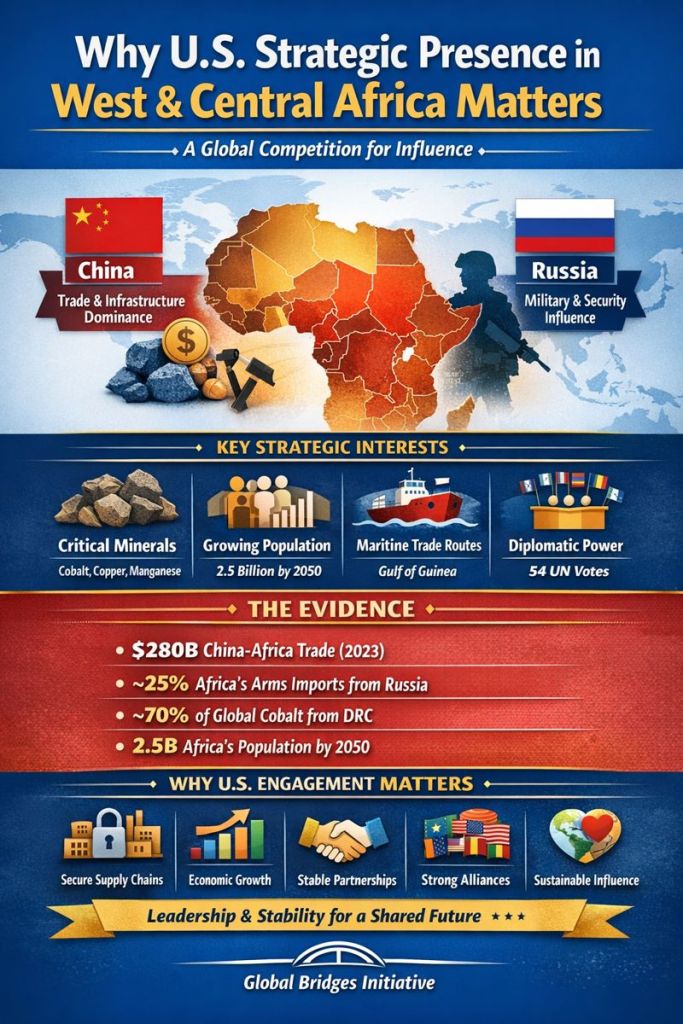
West and Central Africa occupy a pivotal position in the emerging global order because they sit at the intersection of four strategic domains: critical minerals, demographic growth, maritime trade corridors, and international diplomacy.
First, the region is indispensable to the global energy and technology transition. According to the International Energy Agency, the Democratic Republic of Congo alone accounts for roughly 70 percent of global cobalt production, a mineral essential for electric vehicle batteries, aerospace components, and defense technologies (IEA, The Role of Critical Minerals in Clean Energy Transitions). Chinese firms, supported by state-backed finance, dominate much of the upstream and midstream processing infrastructure associated with these minerals, giving Beijing leverage not only over African producers but over downstream industrial economies, including the United States (World Bank, 2018; OECD).
Second, demographic trajectories make Africa economically unavoidable. The United Nations Department of Economic and Social Affairs projects that Africa’s population will reach approximately 2.5 billion by 2050, accounting for more than one quarter of global population growth. West and Central Africa will constitute a significant share of this expansion, producing the world’s largest concentration of new labor-market entrants and consumers (UN DESA, World Population Prospects 2022). Markets of this scale reward early, consistent engagement. Late entry, by contrast, imposes higher political, regulatory, and competitive costs.
Third, the Gulf of Guinea remains one of the world’s most strategically significant maritime corridors. Although piracy incidents declined in recent years, the International Maritime Bureau continues to identify the region as a high-risk zone due to illicit trafficking, illegal fishing, and fragile coastal governance (IMB, Piracy and Armed Robbery Against Ships). Maritime instability directly affects U.S. commercial shipping, energy markets, and insurance costs, underscoring why presence—not episodic patrols but sustained partnership—matters.
Finally, Africa’s diplomatic weight is substantial. With 54 UN member states, the continent represents the largest regional voting bloc in multilateral institutions. Voting patterns surrounding the UN General Assembly resolutions condemning Russia’s invasion of Ukraine illustrate the strategic stakes: while many African states supported condemnation, a significant number abstained, reflecting not ideological alignment but active courtship by competing powers (UN General Assembly Voting Records; Council on Foreign Relations).
Russia and China Are Playing the Long Game
China’s approach to Africa is primarily geoeconomic and structural. It is not limited to trade—which reached over USD 280 billion in 2023 according to China–Africa Research Initiative (SAIS-CARI)—but extends to long-term financing of infrastructure, mining, logistics, and industrial zones. While these investments have produced tangible assets, research by the AidData Lab at William & Mary has documented extensive use of opaque lending arrangements, including previously unreported debt, that complicate fiscal transparency and debt restructuring in borrower states (AidData, Banking on the Belt and Road).
Russia’s strategy, by contrast, has centered on security influence. According to the Stockholm International Peace Research Institute, Russia remains the largest supplier of major arms to Africa, accounting for approximately one quarter of all imports in recent years (SIPRI Arms Transfers Database). In parallel, Russian-linked private military contractors have operated in countries such as Mali and the Central African Republic. United Nations expert panels and Human Rights Watch have documented credible allegations of extrajudicial killings, enforced disappearances, and civilian harm associated with these deployments—dynamics that undermine state legitimacy and fuel long-term instability (UN OHCHR; Human Rights Watch).
These approaches differ in form but share a common feature: they convert presence into leverage. Influence accumulates through repetition, embeddedness, and institutional capture.
Why U.S. Retrenchment Is Strategically Irrational
The case for deeper U.S. engagement is empirical rather than ideological.
First, disengagement does not reduce costs; it defers them. Research on conflict prevention, supply-chain resilience, and crisis response consistently shows that preventive engagement is less costly than reactive intervention (World Bank, Pathways for Peace; RAND Corporation). When the United States withdraws, competitors do not remain neutral—they fill the vacuum, often in ways that later impose higher security and economic costs on U.S. interests.
Second, U.S. comparative advantages align closely with Africa’s long-term development needs. Peer-reviewed evidence synthesized in The Lancet demonstrates that sustained external investments in health systems—much of which have historically been led or co-led by U.S. financing and institutions—have contributed to substantial reductions in preventable mortality and durable improvements in state and institutional capacity across low-income regions, including Sub-Saharan Africa (Jamison et al., 2013). Transparent finance, private-sector–led growth, and independent evaluation are therefore not merely normative preferences; they are empirically grounded conditions under which durable markets, human capital formation, and political stability emerge.
Third, cultural and educational engagement function as strategic infrastructure. The U.S. Department of State and multiple policy analyses have demonstrated that exchange programs, professional training, and people-to-people diplomacy significantly enhance long-term cooperation and reduce transaction costs in trade and security partnerships (U.S. State Department; Brookings Institution). In this domain, U.S. underinvestment creates disproportionate strategic losses.
The Global Bridges Imperative
It is within this context that the Global Bridges Initiative positions itself (in the spirit of similarly committed initiatives) not as a substitute for state power, but as a multiplier of U.S. strategic effectiveness. By facilitating intercultural competence, institutional partnerships, and long-term relational capital, Global Bridges addresses a critical weakness in current U.S. engagement: the gap between strategic intent and sustained presence.
The evidence is clear. Africa is no longer a peripheral arena of global politics. It is a central theater in the competition over supply chains, markets, norms, and alliances. Influence ceded today will not be easily reclaimed tomorrow.
The question, therefore, is not whether the United States can afford to deepen its engagement in West and Central Africa. The evidence suggests the opposite: the United States cannot afford not to.
Select Bibliography
African Development Bank Group. (2024). African economic outlook 2024: Driving Africa’s transformation through inclusive growth. African Development Bank Group.
https://www.afdb.org/en/documents/african-economic-outlook-2024
Note on Reference: Provides authoritative macroeconomic data demonstrating Africa’s growth trajectory and structural constraints, supporting claims that sustained U.S. economic engagement in West and Central Africa aligns with long-term global competitiveness and development stability.
AidData. (2021). Banking on the Belt and Road: Insights from a new global dataset of Chinese overseas development finance (Version 2.0). William & Mary, Global Research Institute.
https://www.aiddata.org/publications/banking-on-the-belt-and-road
Note on Reference: Documents the scale, opacity, and debt-related risks of Chinese overseas lending, empirically substantiating claims that alternative U.S.-aligned development and investment models reduce long-term fiscal and geopolitical risk.
Jamison, D. T., Summers, L. H., Alleyne, G., Arrow, K. J., Berkley, S., Binagwaho, A., … Yamey, G. (2013).
Global health 2035: A world converging within a generation. The Lancet, 382(9908), 1898–1955.
https://doi.org/10.1016/S0140-6736(13)62105-4
Note on Reference: Provides peer-reviewed causal evidence that U.S. foreign assistance produces measurable improvements in population health, supporting the argument that U.S. engagement yields demonstrable and scalable public-good outcomes.
China–Africa Research Initiative. (2024). China–Africa trade database. Johns Hopkins University School of Advanced International Studies.
https://www.sais-cari.org/data-china-africa-trade
Note on Reference: Supplies empirically verifiable trade data showing China’s dominant and expanding economic footprint in Africa, substantiating claims that U.S. absence results in lost market share and strategic leverage.
Human Rights Watch. (2024). Mali: Atrocities by the Army and Wagner Group. Human Rights Watch. https://www.hrw.org/news/2024/12/12/mali-atrocities-army-and-wagner-group
Note on Reference: Documents credible allegations of civilian harm associated with foreign security actors, supporting the argument that security-first partnerships without governance safeguards undermine long-term stability and legitimacy.
International Energy Agency. (2021). The role of critical minerals in clean energy transitions. International Energy Agency.
https://www.iea.org/reports/the-role-of-critical-minerals-in-clean-energy-transitions
Note on Reference: Establishes the strategic importance of African critical minerals to global energy transitions, directly supporting claims that U.S. engagement is necessary to secure resilient and transparent supply chains.
International Maritime Bureau. (2024). Piracy and armed robbery against ships: Annual report 2023. ICC International Maritime Bureau. https://www.icc-ccs.org/reports/2023_Annual_IMB_Piracy_and_Armed_Robbery_Report_live.pdf
Note on Reference: Provides authoritative maritime security data illustrating ongoing risks in the Gulf of Guinea, reinforcing claims that sustained U.S. engagement reduces commercial and security externalities affecting global trade.
Stockholm International Peace Research Institute. (2024). SIPRI arms transfers database. SIPRI.
https://www.sipri.org/databases/armstransfers
Note on Reference: Quantifies arms transfer patterns showing Russia’s dominant role in African security supply chains, evidencing how securitized influence strategies shape dependency and geopolitical alignment.
United Nations Department of Economic and Social Affairs, Population Division. (2022). World population prospects 2022: Summary of results. United Nations.
https://www.un.org/development/desa/pd/content/world-population-prospects-2022
Note on Reference: Provides authoritative demographic projections demonstrating Africa’s centrality to future global labor and consumer markets, substantiating claims of long-term U.S. economic and strategic interest.
United Nations Office of the High Commissioner for Human Rights. (2025). Report of the independent expert on the situation of human rights in Mali. United Nations Human Rights Council.
https://www.ohchr.org/en/documents/country-reports/ahrc5879-situation-human-rights-mali-report-independent-expert-situation
Note on Reference: Offers independent UN documentation of human rights conditions linked to security governance, reinforcing the argument that legitimacy-based engagement is essential for sustainable stability.
World Bank. (2018). Pathways for peace: Inclusive approaches to preventing violent conflict. World Bank.
https://www.worldbank.org/en/topic/fragilityconflictviolence/publication/pathways-for-peace
Note on Reference: Demonstrates through global evidence that preventive, institution-centered engagement is more cost-effective than crisis response, supporting claims that sustained U.S. presence reduces long-term security expenditures.
World Bank. (2024). Global economic prospects (January 2024). World Bank.
https://www.worldbank.org/en/publication/global-economic-prospects
Note on Reference: Provides macroeconomic growth projections showing Sub-Saharan Africa’s continued expansion, empirically supporting the claim that U.S. engagement aligns with future-oriented economic opportunity.
 Global Bridges
Leave a comment